EDC Through the Ages - Ancient Egypt
The concept of everyday carry is as old as the human race. Even our pre-historic ancestors would have had their favourite tools and implements they carried around with them like blades, burnishers, scrapers, hand axes and awls, made from either flint or bone usually.
We thought it would interesting therefore to look at EDC through the ages in this new occasional blog series, and check what tools and materials other civilisations around the world would have used and cherished.
Where better to start then than with the Ancient Egyptian period which the British Museum classifies as; "Ancient Egyptian history spans over 3000 years starting from the unification of Egypt around 3100 BCE until the death of Cleopatra VII and the start of Roman rule in 30 BCE." Can you imagine the advances in our current day EDC in 3000 years time!? We wonder what materials will emerge that we can't even dream of yet?
We have picked out some typical EDC items of the period and even managed to get some amazing photographs to help illustrate them (courtesy of The Met - New York's Metropolitan Museum of Art.)
ANCIENT EGYPTIAN EDC
Knives and daggers
These initially would have been made from flint or obsidian, and then migrated to metal blades over the centuries. Firstly copper, and then the harder bronze alloy fusing copper with tin, developed in nearby Sumeria (now southern Iraq) around 3300 BCE that became the standard. For truly high-status individuals though, the only way to go was meteoric iron if you could get it! King Tutankhamun was famously buried with a dagger made of the very rare and special metal.
These knives and daggers were carried tucked into waist belts and used for cutting food, rope, and other everyday tasks. Handles were typically made from ivory, wood, bone, and of course gold for the VIPs.

Dagger. ca. 1550-1300 BCE. Bronze or copper alloy and ivory. L 38cm/15".
Amulets
These small charms were often shaped like gods or other sacred symbols which covered a multitude of topics in reality from animals of all shapes and sizes, to knots, headrests, hearts and that old favourite, the phallus. People wore, carried, or even wove them into their clothes for luck and protection from evil spirits or danger. You can equate them to good luck charms and charm bracelets in the modern day. They were also used on the dead to afford protection into the afterlife.
They seem to have most often been made from a special ceramic called faience which I had to look up and you can read more on via the link to the name, as they could produce their favoured blue and green colours. As with the examples below though, semi-precious stones, and precious metals like silver and gold were also used, but at the other end of the scale, ceramic and other more everyday metals were also used, presumably to cater for the common Egyptians who also wanted to protect themselves.

Group of amulets . ca.1550-1080 BCE. Includes the tit symbol (pronounced teet - stop that sniggering!) in red jasper that illustrates a knotted piece of cloth.
Kohl Makeup
If you visualise an ancient Egyptian you probably remember the dark eye makeup they typically wore, creating the distinctive almond shaped eye. This was called kohl and when travelling they carried it in small pots which contained a dark green or black mineral paste mixed with fat. This was made from Stibnite (antimony trisulfide) crystals, or other soft minerals like galena (lead ore). It was typically applied with a smooth wooden stick or spatula.
Thanks to historical dramas we mostly think of it as a cosmetic like modern day eyeliner, but apparently it was also used to help protect their eyes from the sun, the same way American footballers now use eye black to avoid glare reflecting into their eyes. A further benefit was that it had anti-microbial properties (since tested and proven) and was used to treat eye conditions such as trachoma.

Kohl Jar and Applicator. ca. 1491-1473 BCE. Serpentinite jar & galena Kohl.
Qenamun and His Wife, Tomb of Qenamun. ca. 1386-1347 BCE. Tempera on paper.
Seal Rings and Scarabs
Personal stamp seals carved with unique hieroglyphic designs or the names of gods were often placed in signet rings, and were used to sign documents, secure storage doors, or stamp baskets of goods. On the one shown below belonging to the Pharaoh Amenothep II, the scarab signet could swivel so they could show the scarab design or the signet underneath as they wished. This was a quite typical design of the time due to its functional as well as decorative use therefore.
Signets were also carved into scarabs, that ubiquitous Egyptian replica of a dung beetle, that thanks to its habit of rolling balls of dung around the desert, was likened to their sun god Khepri, who pushed the sun around the sky. The fact that young beetles also seemed to magically emerge from the dung balls, meant that they also symbolised life and renewal. The replica scarabs were carried as both amulets and seals thanks to their significance to Egyptian culture.

Scarab Signet Ring, Amenhotep II. ca. 1427-1396 BCE. Bronze or copper alloy and steatite (soapstone).
Leather Pouches
How many leather EDC wallets, bags, or purses have you owned over your lifetime? This hardwearing natural product has been used for millennia and the Ancient Egyptians were no different. Their everyday carry were small drawstring bags and pouches made of animal hides or woven plant fibres, and were tied directly to a belt or sash around the waist for fast access. These were in reality some of the very first leather EDC and haven't in fact changed that much over time in terms of their use and popularity.
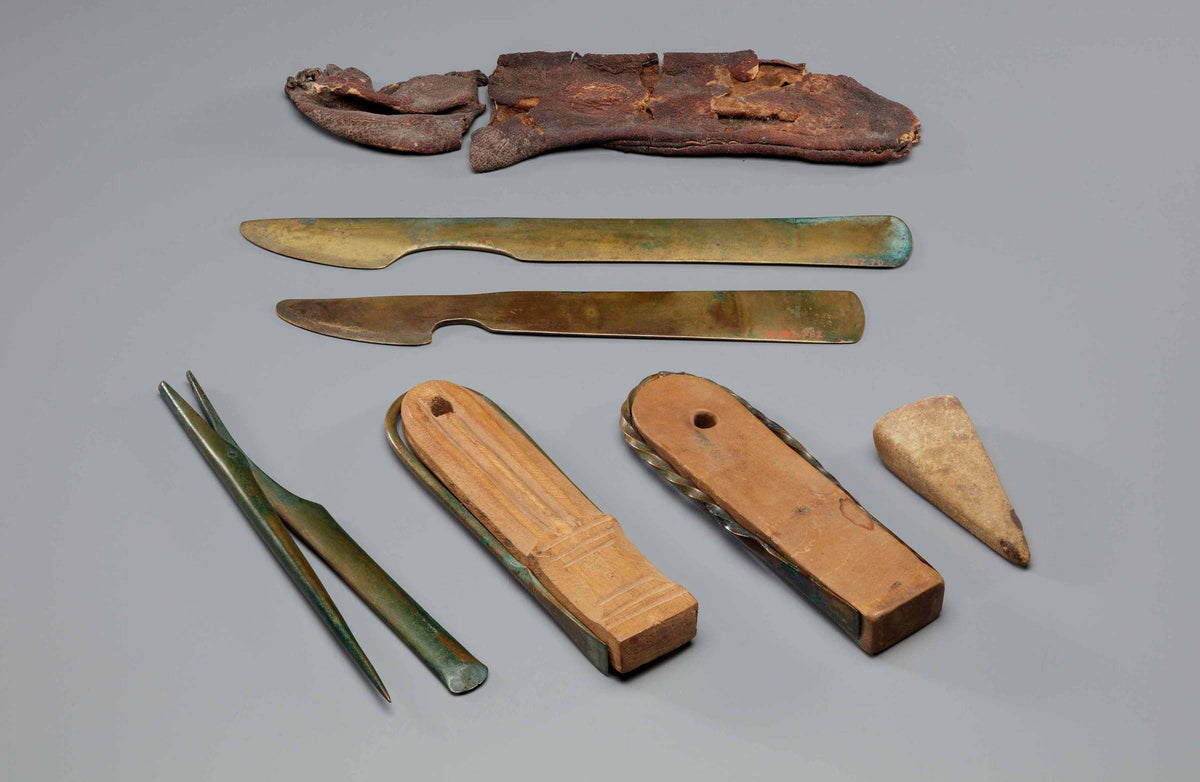
The title photograph to this blog is of the leather pouch as below, along with the contents found inside it that comprised two razors, tweezers, two wooden mounting blocks, and a whetstone. Perhaps not quite what we might carry ourselves these days outside of a toiletry bag on holiday, but back then a small bronze, copper or maybe an obsidian or flint blade would have been used regularly to shave the head and face to stay cool and prevent lice, by both men and women.
The everyday carry need for the pouch has always remained, and was most recently reimagined with our own The Marksman EDC leather EDC utility pouch. We are bound to come across more styles and uses for leather pouches in future blogs I am sure.

Pouch for cosmetic implements. ca. 1550-1300 BCE. Leather. L. 25cm / 9 3/4"
We hope you've enjoyed this first look at EDC through the ages. If you've got any other insights or examples on the Ancient Egyptians and their EDC then please get in touch and let us know.